
Short answer? The community in which you are providing allyship. The long answer can be found below.
al-ahy-ship the status or role of a person who advocates and actively works for the inclusion of a marginalized or politicized group in all areas of society, not as a member of that group but in solidarity with its struggle and point of view and under its leadership:
Genuine allyship does not come with special recognition—we do not get awards for confronting issues people have to live with every day.
“Allyship Definition & Meaning.” Dictionary.com, Dictionary.com, https://www.dictionary.com/browse/allyship.

As someone who leads in the DEI&B space at work, I continuously evaluate biases, discover new ones, and determine if this space still needs my voice. If I am not asking that question frequently, I am not genuinely doing it for the right reasons. What I mean by that is if I am not able to allow other voices to be heard, if I am only presenting one point of view, if I continue to focus on a specific dimension of difference, or if I start to think that my way is the only way, I have lost the path forward.

Recently, I believe I have identified a different type of performative allyship.
“Performative allyship, by contrast, is where those with privilege, profess solidarity with a cause. This assumed solidarity is usually vocalized, disingenuous, and potentially harmful to marginalized groups.”
Performative Allyship: What Are The Signs And Why Leaders Get Exposed by Carmen Morris https://www.forbes.com/sites/carmenmorris/2020/11/26/performative-allyship-what-are-the-signs-and-why-leaders-get-exposed/?sh=3a57f75f22ec
The situation I am thinking of involves a person using their privilege to profess solidarity for equality for Black people; however, this person is focused chiefly on Black cis-gender issues. When I first encountered this person, I was so encouraged. I was so happy to meet an ally. Little did I know that I was being collected as a marker to bring authenticity to this person’s claim of allyship.

When I was first collected, I was invited to events with essential people in the community, invited to Black-owned businesses and volunteer events to help the community. I only started to see cracks in the way that I saw this person when we were volunteering one day at a food shelf. It was a small thing, but when people show you who they are, believe them.

As someone who has utilized a food shelf in the past, I frequently want to ensure that the people who visit them feel safe and proud that they have found a way to take care of their family. Once again, this was something small, but I think it was the first time I started to notice the cracks in the facade. We were loading up a car, and the family that drove up didn’t get one of the emergency relief boxes. This box had all of your essentials to feed a family of 4 for at least 2 weeks. It wasn’t much but with the other supplemental boxes, it was the only one with canned food. Of course, being the awkward duck that I am, I went chasing down the drive box in hand, trying to get them their additional box. I am not a runner. Like at all. So I didn’t catch the car. I went back to our distribution line and that person said, well they have enough. Like I said, it was small but so informative.

There were other things that continued to erode my relationship with this person. As a Black person, I am constantly aware of each murder of an unarmed Black person. I am uniquely aware of the racism shown by shop owners, store workers, and people who I encounter in public. One of the things that stood out to me was, that every time that I was with this person in public, they would point out each time a person did something that they perceived as racist. I even found myself standing up for random strangers just to keep the mood positive. Whenever something would happen to someone in my community, they would send me a video, detailed article, or description of what happened without sharing a trigger warning after I explicitly asked for one. When this person consumed Black culture, it was focused on the victimhood of Blackness, and the trauma porn of our community, OR it was focused on how amazing Black people are.
We are amazing, but that isn’t the point here.
This is where I lost it with this person. I think I may have blogged about this before. But we had a book for book club called “As The Wicked Watch” by Tamaron Hall. Book Description below…

When crime reporter Jordan Manning leaves her hometown in Texas to take a job at a television station in Chicago, she’s one step closer to her dream: a coveted anchor chair on a national network. Jordan is smart and aggressive, with unabashed star-power, and often the only woman of color in the newsroom. Her signature? Arriving first on the scene–in impractical designer stilettos. Armed with a master’s degree in forensic science and impeccable instincts, Jordan has been able to balance her dueling motivations: breaking every big story–and giving a voice to the voiceless.
This book is a murder mystery and the questions added were all about Black trauma. I spoke up prior to us starting the questions, I was surprised and disheartened that this was all someone took out of a book that highlights the complexity of the Black community. I also called out that I had a hard time feeling engaged with the discussion when we were going to spend hours dissecting Black trauma. That discussion was more important than my dissent apparently. I wrote this person a message telling them that I didn’t think that their focus was appropriate given the strong desire to show this group in particular that BIPOC women are more than their trauma. I decided to step back from the book club and now I am blocked. Honestly, my mental health is better for it.
As I am still involved in the DE&I community, I continue to hear about the harm that this person is doing. They continue to create toxic environments that do not promote discussion or learning and if you dare to challenge them, they tend to get upset and profess that their way is the right way.
So, I wrote a lot, but as one of the people who has asked this person to stop doing harm… I am not sure what to do next. I know that some of the work they are doing is good, however, the constant collecting of Black women and men as friends feels targeted and gross. This along with the negative slant that they take discussions is creating a rift for some people that may be irreparable. I have a few more stories, however, I am trying to keep some anonymity.
If you read this far, do you have any advice?
One response to “Who Determines the Effectiveness of an Ally?”

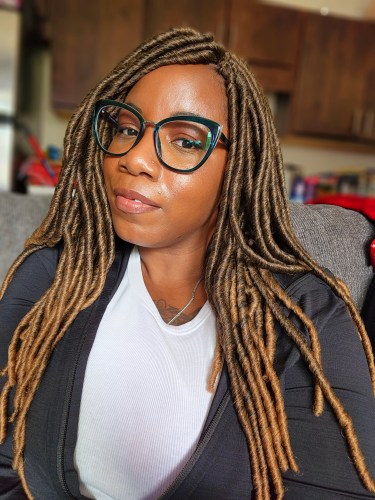
My name is Catherine, I am a Project Manager who is thriving in Minneapolis. I lead two different DE&I Orgs within my current workplace and I am always looking to challenge my assumptions, and highlight my own biases and I want to be proven wrong. This is how I learn best.
Love you!
Catherine




 Adventures of a Lonely, Bookish, Black Girl
Leave a reply to DS Cancel reply