
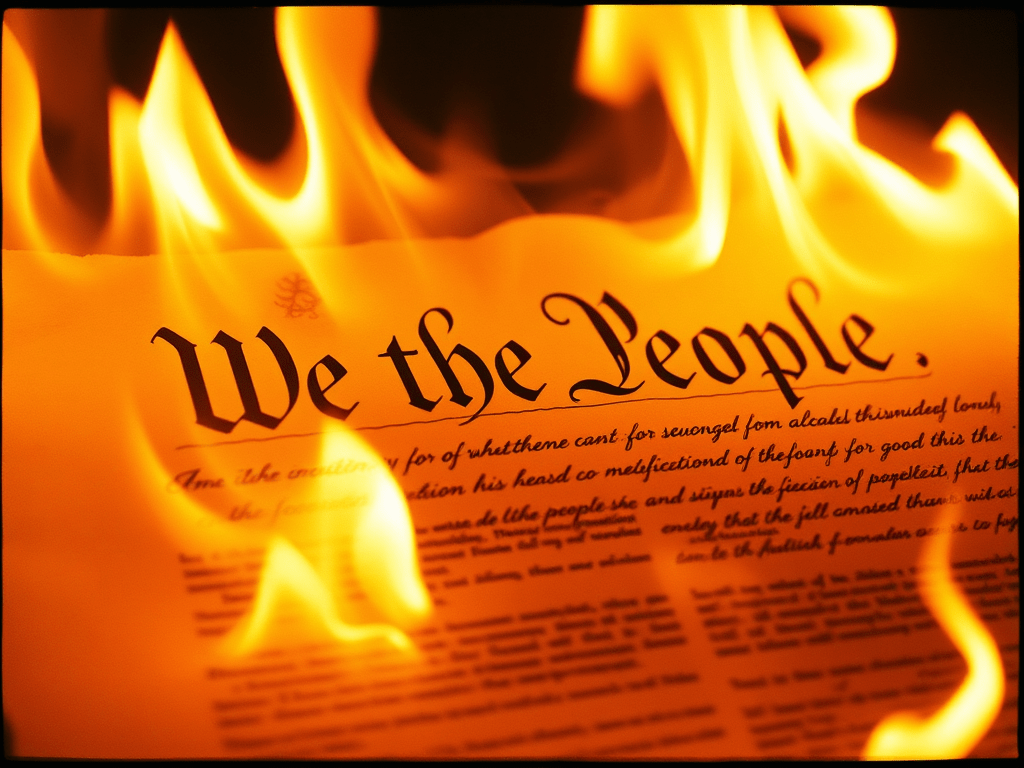
A constitutional crisis happens when the laws, rules, or norms of a government’s constitution no longer clearly resolve a major conflict.
It often involves a serious dispute between different branches of government, leaders refusing to follow constitutional limits, or gaps where the constitution doesn’t provide guidance.
What does this mean for you?
- Increased uncertainty about how government decisions are made.
- Potential loss of rights or protections if constitutional limits are ignored.
- Possible civil unrest or protests as people respond to perceived abuses of power.
- Erosion of trust in democratic institutions.
Implications:
- Rule of Law Weakens – Citizens may not be able to rely on courts or the law to protect them.
- Power Struggles – Leaders might consolidate power illegally, threatening democracy.
- Instability – Economic uncertainty, political violence, or even government breakdown could follow.
- Citizen Action Becomes Critical – Voting, activism, civil resistance, and legal challenges become tools to defend democracy.

This is not new. There have been several Constitutional Crisis’s throughout history.
- United States – 1860 (Pre-Civil War)
- Southern states claimed the right to secede after Lincoln’s election.
- The Constitution did not clearly say whether states could leave the Union.
- Result: Civil War broke out because the constitutional system could not resolve the conflict peacefully.
- United States – 1974 (Watergate)
- President Nixon refused to turn over tapes subpoenaed during an investigation.
- It raised the question: can a sitting president ignore the courts?
- Result: Nixon resigned before he could be removed, but it tested presidential limits.
- United States – 2020 Election Aftermath
- Some officials and citizens refused to accept the certified election results.
- Efforts to overturn results raised constitutional concerns about peaceful transfer of power.
- Result: January 6 Capitol attack showed how fragile constitutional norms can be without citizen and leader buy-in.
- United Kingdom – 2019 (Brexit and Parliament)
- Prime Minister Boris Johnson tried to suspend Parliament for an unusually long time.
- The UK does not have a single written constitution, so it was unclear how to respond.
- Result: Supreme Court ruled the suspension illegal, preserving democratic processes.
- Weimar Germany – 1930s
- Constitutional emergency powers (Article 48) were used frequently.
- Hitler used these powers to erode democracy legally.
- Result: The constitution’s weaknesses enabled dictatorship without outright overthrow.

So, what does this look like in action? These are the warning signs that a country might be approaching a constitutional crisis:
- Leaders openly defy court rulings without consequences.
- Disputed elections where the losing side refuses to accept results.
- Emergency powers are used excessively or indefinitely.
- Attacks on independent institutions (courts, media, election bodies).
- Mass resignations or firings of key officials who refuse to violate the law.
- Changes to constitutional norms without legal amendments (e.g., ignoring term limits, bypassing Congress or Parliament).
- Use of violence or threats to settle political disputes instead of legal processes.
- Major laws are ignored or selectively enforced by the government.
- Citizens are punished for peaceful dissent through arrests, violence, or legal intimidation.
- Rhetoric that dehumanizes political opponents and suggests some people should lose rights based on their views.
Each one alone may not be a full crisis, but multiple signs at once are serious.

What can you do?
- Stay Informed
- Follow multiple credible news sources, not just one.
- Meidas Touch and Zeteo
- Learn how government processes are supposed to work.
- Follow multiple credible news sources, not just one.
- Vote in Every Election
- Local and state elections often impact democracy more immediately than federal ones.
- Organize and Join Civic Groups
- Groups focused on voting rights, civil liberties, and government accountability can amplify your voice.
- Peaceful Protest and Demonstration
- Marches, sit-ins, and rallies signal public disapproval and defend democratic norms.
- Contact Elected Officials
- Call, email, and attend town halls to pressure leaders to uphold the rule of law.
- Support Independent Media
- Subscribe or donate to trustworthy outlets that hold power accountable.
- Educate Others
- Share knowledge about rights, laws, and historical lessons to build a stronger informed community.
- Document Abuses
- If rights are violated, gather evidence (photos, videos, written testimony) safely and legally.
- Protect Vulnerable Communities
- Stand in solidarity with those targeted by unconstitutional policies or rhetoric.
- Stay Calm but Committed
- Authoritarians often provoke chaos to justify crackdowns. Staying peaceful and steady is powerful.
When injustice becomes law, resistance becomes duty!



 Adventures of a Lonely, Bookish, Black Girl
Leave a Reply