
In the last couple of weeks, two major retailers have decided to close their doors in North Minneapolis. The first retailer is Aldi, a discount grocery store that boasts “Low prices. Every aisle. Every day.” The second retailer to close is Walgreens. Walgreens wants to “Create a better world through health and wellness.”
These two retailers are critical to the success of any community. Every community needs a pharmacy and a low price grocery store. Do you know who desperately needs those things? Societies with a history of being persistently poor require resources, such as investments, to ensure success. Lack of access to healthy food options at a low cost and a place to fill prescriptions within walking distance is necessary for the success of any community. Several people, more intelligent than me, have researched the long-term impact of the lack of access to food, or the issue of food deserts.

This type of abandonment of a community is intentional. The question is, what is the moral imperative of companies to ensure that a neighborhood is supported? What is the role of the local government? Of Mayor Jacob Frey? Of Ilhan Omar?
In my experience, the words of a politician hold a lot of weight. The only thing I can surmise is that there is no coordination or desire to ensure that the people of North Minneapolis have an affordable location to get food. Many persistently poor people lack access to reliable transportation, and this gap will hurt this community more than it would in another part of Minneapolis. With that said, most parts of Minneapolis have at least two to three options.
“Food insecurity exists when communities experience inconsistent access to adequate food due to lack of money and other resources. While especially relevant in today’s social climate, food insecurity in and of itself it not a new issue. Historically, there have always been parties who don’t know where or when their next meal will happen, such as early hunter gatherers. However, despite the time elapsed since we transitioned from a nomadic lifestyle, one in six Americans still experience food insecurity, either lacking funds to provide food or lacking access to food (Hartman). The latter can be described using the term food deserts, which are defined as “households being more than a mile from a supermarket with no access to a vehicle” (Chinni). The most recent societal transition from urban life to suburban life has exacerbated food insecurity as wealthy families move out of cities, and grocery stores move with them. For families with cars, this spread of resources doesn’t create a problem, but for families without transportation, the distance to the grocery store, and therefore access to food, can become impassable.”
Tobin , Brielle, and Barbara Lynn Weaver. “Health and Socioeconomic Disparities of Food Deserts.” Global Ecological Humanities, Duke University, 4 May 2017, https://sites.duke.edu/lit290s-1_02_s2017/2017/03/04/health-and-socioeconomic-disparities-of-food-deserts/.
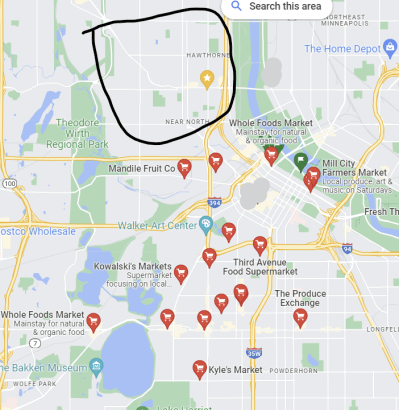
Can you see the disparity? When I first moved to Minneapolis, I had to go to a food shelf because I couldn’t afford groceries. Not being able to find food makes you desperate; the ability to feed your children healthy meals, meals that keep them full and give them the energy to get to school daily, creates so many other problems.
I’m not sure what to do except for heading to a city council meeting or writing the mayor and congresswoman… What retailer is going to step up and fill the void?



 Adventures of a Lonely, Bookish, Black Girl
Leave a Reply